Northamptonshire
Fire and Rescue
Service

About this strategy
This strategy sets out how Northamptonshire Fire & Rescue Service will deliver its Vision and Mission in relation to Prevention, as set out in the Community Risk Management Plan (CRMP) 2025–2030. Each strategy bridges the gap between the service’s high-level strategic priorities and the tactical delivery required across the Service. This strategy covers:
- Strategic direction for business-as-usual (BAU): how the service will maintain statutory and core services over the 5-year period.
- Strategic direction for change efforts: what change and improvements the service will deliver against the 5-Year CRMP and subsequent Annual Delivery Plans.
Each strategy must demonstrate:
- Clear alignment with CRMP strategic priorities and their bullet-pointed commitments.
- Contribution to one or more CRMP strategic outcomes.
- Support for the seven core principles that guide service delivery.
This Prevention strategy outlines the service approach to preventing fires and other emergencies.
It sets out how we will deliver and prioritise prevention activities and how we will allocate resources to ensure we can deliver against our strategic outcome to “Reduce deaths, injuries and damage caused by fire and other events”
This strategy supports the missions within the Police, Fire and Crime Commissioner’s Safe and Sound: Public Safety Plan 2025-2030 and shows how the service will take a prevention first approach, be visible in communities and work closely with partners.
Our Prevention, Protection and Response strategies support an integrated approach to service delivery. This helps us to make the best use of our resources and to prioritise different activities to achieve our Mission – to prevent, protect and respond to keep communities safe.
Strategies form part of the Service’s integrated planning cycle. It informs the 5-Year Programme Plan, guides annual delivery planning, and sets the strategic direction for both business as usual delivery and improvement actions.
The Fire Service National Framework states that Fire and rescue authorities must make provision for promoting fire prevention and focus prevention resources on those individuals or households who are at greatest risk from fire in the home and those most likely to engage in arson or deliberate fire setting.
There is an expectation that the service will work closely with other organisations in the public and voluntary sector, to reduce risk for those identified as vulnerable, including from exploitation or abuse, and wherever possible to share intelligence and relevant risk data.
Given the range of prevention activities including with people with complex needs, the service must ensure that staff in public-facing roles have the necessary skills and training.
Legislative Context and Formal Partnerships
We are committed to working with partners to reduce harm in our communities as part of key “system” approaches outlined below. These helps us to fulfil our legislative duties.
Community Safety Partnerships
Northamptonshire Fire and Rescue Authority have specific responsibilities within the Crime and Disorder Act and the Serious Violence Duty, to contribute to partnership approaches to prevent and reduce crime, anti-social behaviour and serious violence. We are committed to the West and North Northamptonshire Council Community Safety Strategies.
Given our wider prevention role, we are also key partners in the countywide Steering Group to prevent people from becoming terrorists or supporting terrorism under the Prevent Duty.
Integrated Care System
Fire and Rescue Services are explicitly included as part of the wider partnership structure for the Integrated Care System. Given the links between different types of emergencies and the wider determinants of health, NFRS is a key local partner and is committed to working with strategic Health and Wellbeing Boards and in place-based partnerships to improving health, safety and wellbeing and to enable people to live independently. We are committed to the 10 core ambitions of the Live Your Best Life Strategy.
Safeguarding Boards and Partnerships
Safeguarding legislation such as the Care Act 2014 and the Children and Social Work Act 2017 makes provision for Fire and Rescue Services to work as part of safeguarding boards and partnerships in order to protect vulnerable adults and children from abuse and harm and where possible to intervene early to prevent escalation.
Neighbourhood Approach
Through the place-based approach adopted by the Integrated Care System and our Unitary partners we have agreed and committed to delivering our prevention activities in smaller localities or “neighbourhoods”. This enables us to work with partners on initiatives that impact a geographical area and for our firefighters to be at the heart of neighbourhood delivery and to build on their trusted brand within communities. Our work will be data led, focused on reducing risk and being visible to all our communities through localised plans.
The service has a named lead for Prevention and Safeguarding. This role works strategically with system partners and as part of the NFCC Prevention Committee to ensure continuous improvement. This lead works closely with other leads within the NFRS Service Delivery Management Group to agree prevention priorities and to ensure a balanced use of resources across the different priorities of the service.
The central Prevention Department facilitates the development, implementation of strategic plans, policies and processes in relation to prevention and safeguarding and ensures representation at national, regional and local working groups. They work to continuously improve, reviewing and applying learning from our own operational incidents as well as from statutory reviews for Safeguarding Adults and Children, and Domestic Homicides.
The department also includes a small number of prevention professionals who are responsible for delivering more specialist or complex interventions and working with statutory partners. In addition, this team helps to coordinate and support the larger volume of prevention activity delivered by our firefighters in their local neighbourhoods and assists with capacity in on call areas.
The Prevention delivery triangle shows how resources are allocated to maximise the professional expertise of the central delivery staff and the localised capacity of our geographical Community Risk groups.

We have organised our Prevention work into four Priorities for the life of our Community Risk Management Plan.
We will use our own incident data and partnership data to ensure our work is targeted. This will help us to deliver our own strategic aim whilst contributing to local system approaches. Working in this way will allow us to make the best use of service and partner resources.
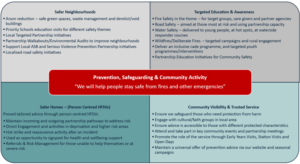
Each priority will be delivered through a range of core activities. The main activities are shown below but we expect to be able to flex and develop these in response to the needs of our communities and partnerships and as local risk profiles change.
These core activities will be recorded using the Community Fire Risk Management Information System (CFRMIS). Data capture is designed to record:
Output – The activity carried out and how/why this was generated.
Time Spent/Productivity – The time spent on activities by different staff groups
Our Reach – The description of our audience/recipients, and number of people reached
Our Impact – We want to ensure that our activities are actually helping to prevent incidents. CFRMIS data, customer feedback, surveys and case studies will also help us to understand the impact our different activities have and to know whether we are reducing risk through improving awareness, changing behaviours and providing interventions.
We recognise that our Prevention work must continue to improve and evolve in order to achieve this. Recent increases in fire fatalities in the home and suicide related incidents mean that we need to make improvements to the way we work with other partners and to the way that we use our own data to understand risk.
To ensure continuous improvement we have made four themed commitments for the life of this strategy and the CRMP. Each commitment aligns to a Prevention Priority and includes a suite of key deliverables which form the basis of our improvement plans for Prevention.
Prevention Commitments 2025-2030
1. We will maximise opportunities to raise awareness and to provide targeted education and build on the success of our Firesetter interventions to help reduce risk and to minimise harm.
By the end of the strategy, we will:
- Reach 35,000 children and young people with safety input in an education setting.
- Provide 100,000 people in our communities with safety awareness and education
- Understand the links between our Firesetter Interventions and serious violence
- Increased the number of Fire Support Volunteers working in the community
2. Review and refresh our delivery of Home Fire Safety Visits, taking a person-centred approach and ensuring we improve information sharing to identify vulnerabilities and target those most at risk.
By the end of the strategy, we will:
- Improve our Community Impact Assessment process to learn from the most serious incidents and fire fatalities, ensuring our findings continue to inform our local activity and to influence national learning.
- Improve training and competency of our staff to deliver HFSVs
- Introduce a quality assurance framework for our HFSV programme
- Enhance our use of CFRMIS to better understand risk and vulnerability
- Improved data sharing and activity with health and social care partners to reduce risk for those with care and support needs
- Embedded a Safeguarding Competency Framework for the whole organisation
- Reach our target of 25000 HFSVs
3. We will maximise fire fighter engagement in all of our communities, providing visibility and an assured service that is accessible to all.
By the end of the strategy, we will:
- Increase the number of HFSVs delivered in non white British households
- Provide regular reporting on our engagement with different seldom heard groups
- Ensure targeted activities are delivered in small towns and rural areas
4. We will work closely with a wide range of local partners to develop our wider community safety role, focused on improving neighbourhoods and creating safer, healthier and more resilient communities.
By the end of the strategy, we will:
-
-
- Ensure our local station plans reflect the wider community safety risks within their area
- Report on the number of targeted community safety activities we have delivered within neighbourhoods, including road safety education initiatives
- Engage with over 600 young people through our targeted early intervention offer
- Maximise joint problem solving approaches to arson and ASB reduction
-
The CRMP 2025-2030 sets out the following strategic outcomes
- Reduce deaths, injuries and damage caused by fire and other hazardous events to our communities.
- Deliver the best value to the public with the least impact on the environment.
- Develop and maintain a deliver a high performing, and healthy workforce.
To help achieve these outcomes we shall:
- Deliver on our commitments and improvement plans to ensure that NFRS achieves the desired outcome set out within the Prevention and Safeguarding Fire Standards.
- A trained and competent workforce to deliver person centred advice and working closely with communities and partner agencies focused to reduce risk of abuse and harm for those who are most vulnerable.
- Reduce community related risks through delivering effective, efficient and targeted prevention activities, working to educate communities to adopt safer behaviours, improving their safety, health and wellbeing.
We shall monitor performance and delivery against our strategic outcomes via a range of Key Performance Indicators (KPI’s) and measures determined by national and local performance reporting criteria, Productivity and Efficiency plan outcomes and assurance requirement.