Northamptonshire
Fire and Rescue
Service

About this strategy
This strategy sets out how Northamptonshire Fire & Rescue Service will deliver its Vision and Mission in relation to the Response function and supported by Operational Support, as set out in the Community Risk Management Plan (CRMP) 2025–2030. Each strategy bridges the gap between the service’s high-level strategic priorities and the tactical delivery required across the Service. This strategy covers:
- Strategic direction for business-as-usual (BAU): how the department will maintain statutory and core services over the 5-year period.
- Strategic direction for change efforts: what change and improvements the department will deliver against the 5-Year CRMP and subsequent Annual Plans.
Each strategy must demonstrate:
- Clear alignment with CRMP strategic priorities and their bullet-pointed commitments.
- Contribution to one or more CRMP strategic outcomes.
- Support for the seven core principles that guide service delivery.
This Response Strategy outlines how the service will respond immediately and effectively to emergency incidents.
It sets out how we will deliver and prioritise response activities and how we will allocate resources to ensure we can deliver against our strategic outcome to “Reduce deaths, injuries and damage caused by fire and other events”.
This strategy is produced jointly with the Response and Operational Support departments. The Response department is responsible for all Fire Stations across the county and the Operational Support function has responsibility for all training, development and operational preparedness.
This strategy supports the missions within the Police, Fire and Crime Commissioner’s Safe and Sound: Public Safety Plan 2025-2030 and shows how the service will take a prevention first approach, be visible in communities and work closely with partners.
Our Prevention, Protection and Response strategies support an integrated approach to service delivery. This helps us to make the best use of our resources and to prioritise different activities to achieve our Mission – to prevent, protect and respond to keep communities safe.
In line with its statutory responsibilities under the Fire and Rescue Service’s Act 2004, the Civil Contingencies Act 2004 and the Fire and Rescue Services National Framework, Northamptonshire Fire and Rescue Service (NFRS) provides a range of response capabilities to ensure it is capable of dealing with the full range of emergencies and hazards that it could reasonably be expected to attend. These emergencies may occur locally, regionally or nationally.
Resource and Delivery model
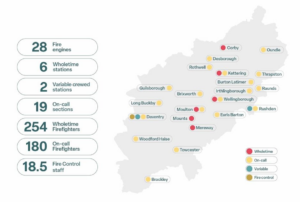
*Data as at 31/10/2025 (establishment)
In addition to the 434 firefighters working in the county, we also have 51 dedicated fire staff members supporting multiple internal departments, including Prevention, Protection and Business Services, as well as 18.5 Fire Control operators taking emergency calls. NFRS are supported by a joint Enabling Services function with Northamptonshire Police that provides IT, Fleet, HR, Financial, Procurement and Data support.
To ensure we can respond effectively to a range of hazards and incidents, the 28 fire appliances based in the 22 stations are assisted by specialist appliances, which include 2 aerial high reach appliances, 2 specialist vehicles supporting water or animal rescues, and further specialist vehicles such as – Technical Rescue vehicle, water carrier/Pod, Foam Pod, Tactical intervention vehicles, High Volume Pump, Mass Decontamination Unit and response cars/4×4 capability.
Wholetime stations are crewed 24/7. Variable crewed stations operate 0730hrs – 1800hrs with on-call supporting 24/7.
On-call stations are crewed by firefighters that live or work within 8 minutes of the fire station and mobilised via an alerter/pager in the event of an emergency.
Operating context and drivers for change
The Fire and Rescue Services Act 2004 sets out the responsibilities of Fire and Rescue Authorities (FRAs). These include:
- Extinguishing fires in their area
- Protecting life and property in the event of fires in their area
- Rescuing and protecting people in the event of a road traffic collision, and
- Rescuing and protecting people in the event of other emergencies.
Services also need to collect information to assess risk in their areas as well as protect the health and safety of their employees. This information is then used to inform decisions about Assets (locations and crew make up of stations, types of vehicles needed), Workforce (skills, training, numbers), Prevention activity (key groups to focus on), Protection activity (for commercial premises and compliance with Fire regulations) as well as multi-agency joint activity.
Northamptonshire Fire and Rescue Service (NFRS) discharge this responsibility within its Strategic Assessment of Risk (SAR) document. This sets out our understanding of risks from four areas:
- Our local communities including businesses
- Our own assets and their capability and capacity
- Wider factors that could influence our response or future planning
- Our demands and performance against hazards we deal with
This understanding informs how we deliver an effective emergency response reliant on operational preparedness and maintained through continuous learning and improvement.
Operational Preparedness
Operational preparedness involves ensuring:
- We have an appropriate fleet of fire appliances and specialist assets, located according to risk
- We have Fire control staff and crews who are well trained, with a mix of skills, ready to deal with any type of incident
- We have the systems, processes and information to support safe and effective working, including interoperability with other agencies
The number of fire stations we have, the number of fire engines we have, and the number and type of specialist vehicles forms our response model. This is based on historical incident demand, a review of low frequency high risk incident types and a future look at predicted demand and risk through our Strategic Assessment of Risk.
Our current Operational response model meets the following outputs:
- Maintain a resilient 24/7 model to receive emergency calls and mobilise operational resources
- Have a specialist appliance response capability to effectively support the following incident categories:
- Large transport incidents
- Water and flood rescue
- Rescue from height
- Animal Rescue
- Hazardous Materials
- Humanitarian
- Maintain a resilient officer command rota to meet the incident requirements as above
- Support multi-agency major incidents by having officers trained to support and where necessary lead Tactical and Strategic Coorindination Groups (TCGs and SCGs).
- Maintain a Mass Decontamination capability to support local and national incidents.
- Maintain a HVP capability to support local and national incidents.
- Maintain a DEFRA flood response capability to support local events and national incidents.
- Maintain a cadre of National Inter-Agency Liaison officers (NILO’s) to respond and support the response to high threat incidents locally, regionally and nationally.
Local Resilience Forum Partnership
A local resilience forum (LRF) is a multi-agency partnership that brings together emergency services, local authorities, government agencies and other key organisations to prepare for and support the multi-agency response to major incidents.
As a category one responder, as defined under the Civil Contingencies Act 2004, we play a critical role in the LRF, working alongside other partners to enhance community resilience. Key responsibilities of the LRF include:
- Emergency planning and preparedness
- Incident response and coordination
- Public safety and community engagement
- Recovery and business continuity
- Multi-agency coordination
Operational response
We align our ways of working to national operational guidance (NOG), to ensure the adoption of best practice. We undertake regular exercises, some of them involving other partner agencies, to test our response and assure the effectiveness of our plans and preparations.
When responding to incidents we are often working alongside crews from neighbouring services and other blue light partners and agencies. We have embedded JESIP (Joint Emergency Services Interoperability Principles) to ensure a common operational model at large multi-agency incidents.
We have mutual aid agreements (Section 13/16) in place with neighbouring services, which allow for crews to be mobilised to incidents in each other’s areas where additional resources or support are required. During the life of this strategy, we will refresh our mutual aid agreements.
Our Fire control operators, crews and officers need to be highly trained and competent to deal with a wide range of incidents. They are also integral to the delivery of our prevention and protection delivery and the ongoing engagement with our communities. We will maintain a balanced workload of prevention, protection and engagement activities alongside the operational preparedness and response activities that crews undertake.
Operational Learning
Every incident we attend provides an opportunity for learning, to improve future response and ensure the safety of firefighters and others involved in or attending incidents. We do this through debriefing and assurance of incidents. We capture and share learning locally, regionally and nationally, and take the learning shared by others to inform our own practices. We use National Operational Learning and Joint Operational Learning, and findings of national inquiries, to improve our ways of working and preparedness for incidents.
Response Commitments 2025 – 2030
1. Review our Standards of Operational Response and take an evidence-based approach to understanding and improving the way we use our frontline resources.
We will:
- Continuously monitor our response times to incidents and review the locations and use of resources to ensure we achieve a timely and effective response, including a review of strategic cover resourcing to risk.
- Identify and action ways to mitigate risk, and therefore reduce likelihood, of emergencies in areas where meeting our response standards is more challenging.
- Collaborate with partner agencies to ensure our response to mental health related incidents (including suicides) follows best practice and delivers a person-centered approach.
- Review our fleet and equipment requirements to ensure readiness, efficiency, and alignment with our risks and service demands.
- Commit to maintaining effective operational response and assurance of National Resilience assets.
- Invest in our staff to ensure they have the right skills and experience to deal with all the potential threats that face our communities.
- Use technology to easily capture and share local risk information to enhance prevention, protection and response.
- Consider if combining identified local on-call stations would aid effectiveness.
2. As a key partner within the Northamptonshire Local Resilience Forum, ensure we support communities and are prepared to respond effectively when large scale emergencies affecting communities happen.
We will:
- Actively engage in the LRF at all governance levels aligning to the principles of JESIP, demonstrating our commitment to collaboration, whilst maintaining robust emergency response plans.
- Anticipate and review risk assessments and response capabilities based on emerging threats and contributing to the community risk register in Northamptonshire.
- Ensure we are prepared for when major incidents happen, embedding JESIP principles at all levels to support an effective multi-agency response.
- Enhance our planning and delivery of multi-agency exercises to ensure an effective and integrated response to large-scale hazardous events.
3. Review our Fire Control capability to enhance resilience, functionality and performance as a core function at the centre of our service delivery to help keep our communities safe.
We will:
- Review our fire control governance ensuring the function is at the heart of the organisation.
- Assure the effectiveness of call handling and mobilisation times.
- Ensure Fire Control are fully embedded in testing and exercising. This will be both from a single agency and a multi-agency approach with LRF partners.
- The Service will explore the introduction of a live time resources management tool (such as the Dynamic Cover Tool) to support efficient and effective decision-making associated with operational resource deployment.
- Explore the use of technological applications and solutions in collaboration with Northamptonshire Police to maximise the situational awareness and effectiveness of control rooms.
- Enhance how we warn and inform the public during our response to an incident by sharing guidance via our website.
4. Ensure the service is fully prepared to respond to the impacts of climate change, supporting communities preparing for and responding effectively to wildfires and floods.
We will:
- Adapting to changing demands – Enhance our flood response capabilities, expanding the number of stations trained and equipped to respond to our local risk.
- Enhance the ability for the landowners to share risk information and capabilities to assist in the management of wildfires.
- Enhance knowledge and understanding of Incident Command in relation to Wildfires
- Review personal protective equipment to ensure our staff are safe to undertake their roles.
- Review Vehicles and Equipment to ensure we provide effective means for our staff to manage Wildfires based on emerging trends and risks.
The CRMP 2025-2030 sets out the following strategic outcomes
- Reduce deaths, injuries and damage caused by fire and other hazardous events to our communities.
- Deliver the best value to the public with the least impact on the environment.
- Develop and maintain a deliver a high performing, and healthy workforce.
To help achieve these outcomes we shall:
To help achieve these outcomes, the aims of this strategy are to:
- Continually update our understanding of risk, and plan and train for all foreseeable threats, so we can respond as effectively as possible when an emergency occurs.
- Work in an integrated way with partners to ensure our planning, training and response is as effective as possible to our communities.
- Provide support to other fire and rescue services and partners.
- Continually monitor and evaluate our performance and procedures and implement lessons from operational/organisational learning and external bodies to drive continuous improvement.
- Invest in new technology, appliances and equipment to ensure our response to emergencies is as safe and effective as possible.
- Protect the environment and protect our communities from the impacts of the climate change.
We shall monitor performance and delivery against our strategic outcomes via a range of Key Performance Indicators (KPI’s) and measures determined by national and local performance reporting criteria, Productivity and Efficiency plan outcomes and assurance requirements.