Northamptonshire
Fire and Rescue
Service

CIPFA Treasury Management in the Public Services: Code of Practice and Cross Sectoral Guidance Notes
The Chartered Institute of Public Finance and Accountancy (CIPFA) defines treasury management as “the management of the organisation’s investments and cash flows, its banking, money market and capital market transactions; the effective control of the risks associated with those activities; and the pursuit of optimum performance consistent with those risks.”

The CIPFA Prudential Code for Capital Finance in Local Authorities (the Prudential Code) is a professional code of practice. Authorities have a statutory requirement to comply with the Prudential Code when making capital investment decisions and carrying out their duties under Part 1 of the Local Government Act 2003 (Capital
Finance etc. and Accounts).
The CIPFA Prudential Code sets out the manner in which capital spending plans should be considered and approved, and in conjunction with this, the requirement for an integrated treasury management strategy.
The Northamptonshire Commissioner Fire & Rescue Authority (NCFRA) is required to set and monitor a range of prudential indicators for capital finance covering affordability, prudence, and a range of treasury indicators.
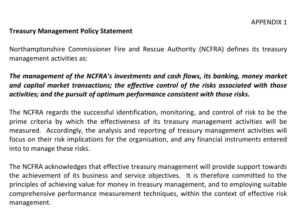
The NCFRA’s Treasury Management Policy Statement is included in Appendix 1. The policy statement follows the wording recommended by the latest edition of the CIPFA Treasury Code.
The NCFRA’s Treasury Management Practices (TMPs) will set out the manner in which the NCFRA will seek to achieve its treasury management policies and objectives, and how it will manage and control those activities.
The NCFRA’s TMPs Schedules will cover the detail of how the NCFRA will apply the TMP Main Principles in carrying out its operational treasury activities. They are reviewed annually, and any amendments approved by the NCFRA’s Chief Finance Officer.
It is a requirement under the Treasury Code to produce an annual strategy report on proposed treasury management activities for the year. The purpose of the Treasury Management Strategy is to establish the framework for the effective and efficient pg. 2
management of the NCFRA’s treasury management activity, including the NCFRA’s investment portfolio, within legislative, regulatory, and best practice regimes, and balancing risk against reward in the best interests of stewardship of the public purse.
The NCFRA’s Treasury Management Strategy is prepared in the context of the key principles of the Treasury Code and incorporates:
• The NCFRA’s capital financing and borrowing strategy for the coming year.
• Policy on borrowing in advance of need.
• Policy on the making of Minimum Revenue Provision (MRP) for the repayment of debt.
• The Affordable Borrowing Limit.
• The Annual Investment Strategy for the coming year, including creditworthiness policies.
The strategy considers the impact of the NCFRA’s Medium Term Financial Plan (MTFP), its revenue budget and capital programme, the balance sheet position, and the outlook for interest rates.
The NCFRA regards the successful identification, monitoring, and control of risk to be the prime criteria by which the effectiveness of its treasury management activities will be measured. The Treasury Management Scheme of Delegation is detailed within the NCFRA’s Corporate Governance Framework.
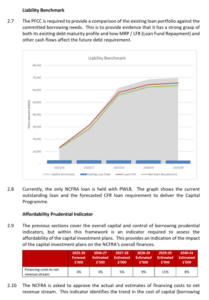
The NCFRA’s projected treasury portfolio position at 1st April 2026, with forward projections into future years, is summarised below. Table 1 shows the actual forecast external borrowing (the treasury management operations), against the Capital Financing Requirement (CFR).
The CFR is the total of outstanding capital expenditure which has not yet been paid for from either revenue or capital resources. It is essentially a measure of the NCFRA’s underlying borrowing need.
Any capital expenditure which has not immediately been paid for will increase the CFR.
The CFR does not increase indefinitely, as the MRP is a statutory annual revenue charge which broadly reduces the borrowing need over each asset’s life.
Table 1: Capital Financing Requirement
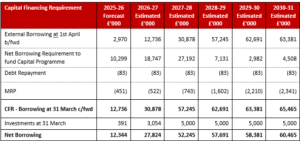
There are a number of key indicators to ensure that the NCFRA operates its activities within well-defined limits. Among these the NCFRA needs to ensure that its gross borrowing does not, except in the short term, exceed the total of the CFR in the preceding years. This ensures that borrowing is not undertaken for revenue purposes
except to cover short term cash flows.
The Chief Finance Officer does not envisage borrowing for investment purposes, nor difficulties complying with these indicators based upon current commitments, existing plans, the proposals in this strategy, the budget report, the Capital Programme and
the Medium Term Financial Plan.
The NCFRA’s assessment of the likely path for bank base rate, investment market rates (The London Interbank Bid Rate – LIBID), and PWLB borrowing rates are set out below:
Table 2: Interest Rate Outlook as at 4th February 2026
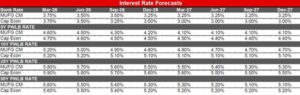
The economic situation to the UK resulted in a steep interest increase which impacted early 2024/25. In December 2024 the Bank of England base rate decreased to 4.5% compared to 5.25% in March 2023. The Bank of England forecasters were expecting base rate to begin to dip in the short term future, falling to 4.05% from 4.5% during the final quarter of 2026/27. The table above shows the interest rates reducing quicker than estimated in 2026/27. The table shows a further decline in the interest rates, levelling to 3.25% for Quarter 3 2026/27. The forecast table above shows the current forecast of the PWLB interest rates from our Treasury Advisors.
Investment returns are likely to slightly decrease in 2026/27 from the interest earnt in 2025/26 due to the decrease in rates and lower anticipated cash balances, and then continue to decline over the medium term.
In March 2020, the Government started a consultation process for reviewing the margins over gilt rates for PWLB borrowing for different types of PFCC capital expenditure. Following the consultation, the Government published their responses in November 2020 which stated these outcomes:
• PWLB will not lend to a PFCC who intends to buy investment assets primarily for yield.
• Reduction to the interest on borrowing on all standard and certainty rates by 100 basis point which took effect from 26th November 2020.
In order that the NCFRA can maximise income earned from investments, the target for the un-invested overnight balances in our current accounts is usually always lower than £10k where possible. However, if there is an emergency, we are unable to place an investment or it is not prudent or cost-effective to do so, we will maintain any excess balances in the NatWest account in order to safeguard funds.
The average cash available to or forecast to invest throughout 2025/26 including a projection of 2026/27 is as follows, which includes fluctuations due to the timing of borrowing for capital expenditure.
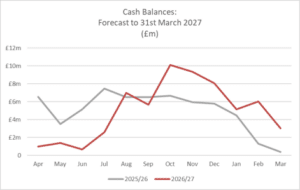
At any one time, the NCFRA tries to maintain between £0.5m and £15.0m (depending on the cash flow of both revenue and capital financing) available to invest. Where this is not possible due to the utilisation of Internal Borrowing to support the costs of the capital programme in order to reduce debt costs, the NCFRA will ensure that positive cash flows are maintained using short term borrowing where necessary.
As with most local authorities with a high proportion of employee to Supplies and Services expenditure, the NCFRA’s cash flow is fairly consistent month on month and therefore investable cash balances only significantly deviate when single payments (such as internally funded capital purchases) or large annual income receipts are forecast.
The increase and decline in cash balances represented above occurs with the:
• Receipt of Annual Managed Expenditure (AME) Grant for firefighter pensions during August.
• The costs associated with the firefighter pensions being expended throughout the financial year.
• Repayment of PWLB loans and planned borrowing.
• Precept income being receivable over the first 10 months of the financial year.
The overarching objectives for the NCFRA’s borrowing strategy are as follows:
• To manage the NCFRA’s debt maturity profile. This is achieved by monitoring short- and long-term cash flow forecasts in tandem with balance sheet analysis.
• To maintain a view on current and possible future interest rate movements, and to plan borrowing accordingly. This is achieved by monitoring of economic commentary to undertake sensitivity analysis.
• To monitor and review the balance between fixed and variable rate loans against the background of interest rates and the Prudential Indicators; this is achieved by monitoring of economic commentary to undertake sensitivity analysis.
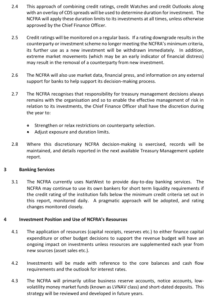
The NCFRA is currently maintaining an under-borrowed position. This means that the capital borrowing need (the Capital Financing Requirement) will not been fully funded with loan debt as cash supporting the NCFRA’s reserves, balances and cash flow has been used as a temporary measure.
The sources of borrowing;
• PWLB – the NCFRA will receive a ‘Certainty Rate’ which is reduced by 20 basis points (0.20%) against the PWLB standard rate.
• Local Authorities, particularly for short-term borrowing.
• OPFCC (Police funds) – this Strategy enables that if there is an instance that either NCFRA or OPFCC (Police) has similar term excess of funds when the other entity has a borrowing need, that borrowing can take place from either party. This must be mutually beneficial and hold minimal risk and to provide additional assurance, approval will be provided by both s151 officers or their deputies, so that both parties interests are demonstrably represented. It ensures that interest rates are competitive to the market and no broker fee is payable (historically 10 basis points
of the amount borrowed).
Caution will be adopted with the 2026/27 treasury operations against this background and the risks within the economic forecast. The Joint Finance Team will monitor interest rates in financial markets and regularly brief the Chief Finance Officer so the NCFRA may adopt a pragmatic approach to changing circumstances. For example:
• If it was felt that there was a significant risk of a sharp FALL of 25% or more in long-and short-term rates (eg. due to a marked increase of risks around a relapse into recession or of risks of deflation), then long term borrowings may be postponed and potential rescheduling from fixed rate funding into short term borrowing considered (where appropriate).
• If it was felt that there was a significant risk of a much sharper RISE of 25% or more in long and short-term rates than that currently forecast (eg. arising from an acceleration in the start date and rate of increase in central rates in the USA and UK) then the portfolio position will be re-appraised. This may include drawing fixed rate funding whilst interest rates are lower than they are projected to be in the next few years.
There is a requirement under the Local Government Act 2003 for Authorities to have regard to CIPFA’s Prudential Code for Capital Finance in Local Authorities (the “CIPFA Prudential Code”) when setting and reviewing their Prudential Indicators. The Prudential Code was most recently updated in 2021.
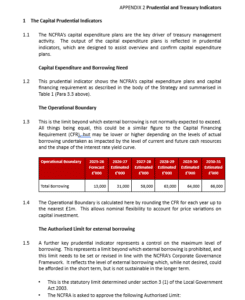
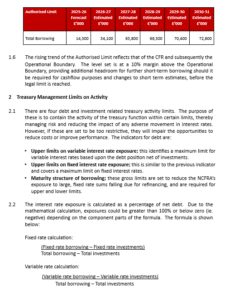
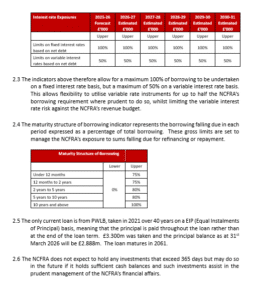
A full set of Prudential Indicators and Borrowing Limits are shown in Appendix 2.
The NCFRA’s policy is to keep cash balances as low as possible and not to borrow in advance of need for capital purposes, whilst ensuring that cash is available to make payments when they become due. However, this policy may be reviewed should it be prudent to do so, subject to support by the Chief Finance Officer.
The NCFRA may reschedule debt if it is prudent to do so. The reasons for any rescheduling to take place may include:
• the generation of cash savings and/or discounted cash flow savings.
• helping to fulfil the treasury strategy regarding the capitalised asset purchases.
• Enhance the balance of the portfolio (amend the maturity profile and/or the balance of volatility).
Any rescheduling activity decision must be recommended by the Chief Finance Officer, and reported in the next Treasury Management report following its action.
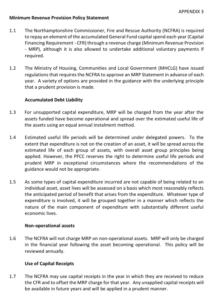
The NCFRA is required to repay annually an element of its outstanding capital expenditure which has not yet been paid for from either revenue or capital resources (the CFR). This is achieved through a revenue charge known as the Minimum Revenue
Provision (MRP). It is also allowed to undertake additional voluntary payments (Voluntary Revenue Provision – VRP) if it is prudent to do so.
MHCLG regulations have been issued which requires the NCFRA to approve an MRP Statement in advance of each year. A variety of options are provided so long as there is a prudent provision. The NCFRA is recommended to approve the MRP Policy in Appendix 3 which sets out how MRP will be charged against particular asset types or other forms of capital expenditure.
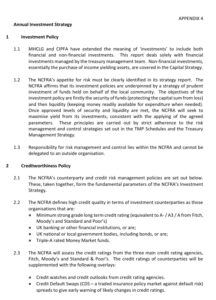
Government guidance on Local Government Investments in England requires that an Annual Investment Strategy (AIS) be set. The Guidance permits the Treasury Management Strategy Statement (TMSS) and the AIS to be combined into one document.
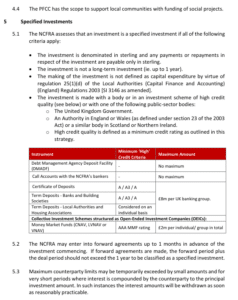
The NCFRA’s general policy objective is to invest its surplus funds prudently. As such the NCFRA’s investment priorities, in priority order, are:
1. Security of the invested capital.
2. Liquidity of the invested capital.
3. Yield received from the investment.
The following graph demonstrates interest earned (cumulative) against the profiled budget, projected to the end of the financial year for 2025/2026:
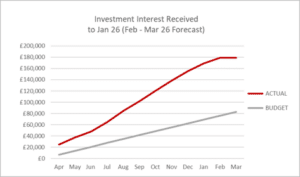
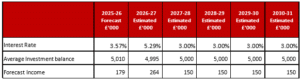
The NCFRA expects to invest all surplus funding and is forecast over the medium term that interest rate returns are expected to decrease. The average cash balances from those is expected to remain consistent with peaks in August following the receipt of grant income with reductions in available levels through to the end of each financial year. An estimate of possible income is as follows:
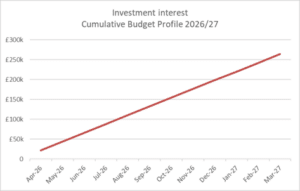
The following graph shows the profiled interest income budget for 2026/27:
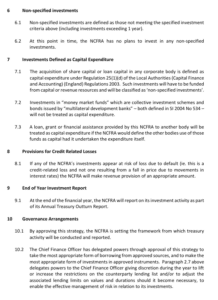
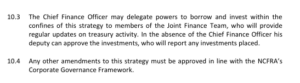
The NCFRA’s Investment Strategy is shown in Appendix 4.
Risk Management
The NCFRA regards the successful identification, monitoring and control of risk to be the prime criteria by which the effectiveness of its treasury management activities will be measured. Treasury management risks are identified in the NCFRA’s approved
Treasury Management Practices.
The Schedule of Treasury Management Practices set out the ways in which the NCFRA seeks to mitigate these risks. Examples are the segregation of duties (to counter fraud, error and corruption), and the use of creditworthiness criteria and counterparty limits (to minimise credit and counterparty risk). Officers will monitor these risks closely.
Sensitivity of the Forecast
The sensitivity of the forecast is linked primarily to movements in interest rates and in cash balances, both of which can be volatile. Interest rates in particular are subject to global external influences over which the NCFRA has no control.
Both interest rates and cash balances will be monitored closely throughout the year and potential impacts on the NCFRA’s debt financing budget will be assessed. Action will be taken as appropriate, within the limits of the TMP Schedules and the treasury
strategy, and in line with the NCFRA’s risk appetite, to keep negative variations to a minimum. Any significant variations will be reported in the next available Treasury Management report.
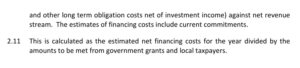
CIPFA’s revised 2021 Prudential and Treasury Management Codes requires all local authorities, to have in place a Capital Strategy, which will provide the following:
• a high-level long-term overview of how capital expenditure, capital financing and
treasury management activity contribute to the provision of services.
• an overview of how the associated risk is managed.
• the implications for future financial sustainability.
The aim of this Capital Strategy is to ensure a full understanding of the overall long term policy objectives and resulting capital strategy requirements, governance procedures and risk appetite.
NCFRA publishes a Capital Strategy which is aligned to the Police, Fire and Crime Plan. The Capital Strategy will be reviewed and updated in line with the new Police, Fire and Crime Plan for 2026/27.
The PFCC receives two treasury reports as a minimum each year, with a mid-year update as and when appropriate, which incorporate a variety of policies, estimates and actuals:
a) Treasury Management Strategy and Prudential and Treasury Indicators (this report – essential report) This report is forward-looking and covers:
• the capital plans (including prudential indicators)
• a Minimum Revenue Provision (MRP) policy (how residual capital expenditure is charged to revenue over time)
• the Treasury Management Strategy, (how the investments and borrowings are to be organised), including treasury indicators.
• an Investment Strategy, (the parameters on how investments are to be managed)
b) A mid-year treasury management report (as required) This is primarily a progress report and updates on the capital position, amending prudential indicators as necessary, and whether any policies require revision.
c) An annual treasury outturn report (essential)
This is a backward-looking review document and provides details of a selection of actual prudential and treasury indicators and actual treasury operations compared to the estimates within the strategy.
The table below provides a breakdown of the treasury management budget. Minimum Revenue Provision (MRP) charges have been calculated in line with the Policy at Appendix 3:
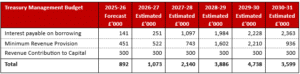
Budget estimates will be revised during the year to reflect the further development of capital programme plans and other relevant strategies.
The NCFRA recognises that responsibility for treasury management decisions always remains with the organisation. The NCFRA also recognises there is value in employing an external provider of treasury management services in order to acquire access to specialist skills and advice to support the treasury management function.
Treasury Management services are undertaken by the Enabling Services Joint Finance Team and the Treasury Advisor is currently MUFG (previously known as Link Group).
Public bodies are having to consider innovative strategies towards improving service provision to their communities. This approach to innovation also applies to treasury management activities. The Government has already introduced new statutory powers, and regulatory agencies such as CIPFA are introducing policy changes, which will have an impact on treasury management approaches in the future. Examples of such changes are:
Localism Act A key element of the Act is the “General Power of Competence”: “A PFCC has power to do anything that individuals generally may do.” The Act opens up the possibility that a PFCC can use derivatives as part of their treasury management operations. The NCFRA has no plans to use financial derivatives under the powers contained within this Act.
Loans to Third Parties The NCFRA may borrow to make grants or loans to third parties for the purpose of capital expenditure. This will usually be to support local economic development, and may be funded by external borrowing. The NCFRA has not lent any funds to third parties and has no plans to do so in the immediate future.
Proposals to amend the CIPFA Treasury Management and Prudential Codes CIPFA conducted a review of the Treasury Management Code of Practice and the Prudential Code. This review particularly focused on non-treasury investments and especially on the purchase of property with a view to generating income. Such purchases could involve undertaking external borrowing to raise the cash to finance these purchases, or the use of existing cash balances. Both actions would affect treasury management. The Capital Strategy will cover non-treasury investments to deal with such purchases, their objectives, how they have been appraised, how they have been financed, and what powers were used to undertake these purchases.
Impact of International Financial Reporting Standard 9 (IFRS 9)
All public bodies were required to adopt the principles of accounting standard IFRS 9 from 1st April 2018, this was amended 1st January 2026 for guidance with ESG (Environmental, Social and Governance) linked investments. A key element of this standard is a requirement to set aside financial provision within revenue budgets for losses on financial assets based on potential expected losses (i.e. the likelihood of loss across the asset lifetime). This does not have a material impact upon the traditional treasury management investments the NCFRA will undertake.
The NCFRA needs to ensure appropriate training and knowledge in relation to treasury management activities, for officers engaged in treasury activity and those with oversight responsibilities charged with governance of the treasury management function. Treasury management training will be considered and delivered as required
to facilitate best practices, informed decision making and challenge processes.
Appendix 1: Treasury Management Policy Statement
Appendix 2: Prudential & Treasury Indicators
Appendix 3: Minimum Revenue Provision (MRP) Policy Statement
Appendix 4: Annual Investment Strategy