
Northamptonshire
Fire and Rescue
Service

This capital strategy provides a high-level overview of how capital expenditure, capital financing and treasury management activity contribute to the provision of fire services along with an overview of how associated risk is managed and the implications for future financial sustainability.

Decisions made each year on capital and treasury management will have financial consequences for the organisation for many years into the future. They are therefore subject to both a national regulatory framework and to local policy framework, summarised in this report.
The Capital Strategy supports the strategic direction set out within the Police, Fire and Crime Plan and the Chief Fire Officer’s Strategic Plan. These strategic documents are supported by other documents including the Treasury Management Strategy, Digital Strategy and a Joint Police/Fire Assets Strategy. The Assets Strategy incorporates Fleet, Estates and Commercial across both police and fire, and sign-posts to governance processes and structures that facilitate robust delivery.
Capital expenditure is where the Police, Fire and Crime Commissioner (PFCC) spends money on assets, such as property, IT or vehicles that will be used for more than one year. The PFCC has some discretion on what counts as capital expenditure. The current
policy sets out that assets costing less than £6k are not capitalised and are charged to revenue in-year.
The programme is regularly updated to reflect year end outturn, in year progress and changes to operational and strategic delivery requirements. The key capital projects included in these plans are provided later in this strategy. Should these materially change for whatever reason, this document will be formally reviewed and updated.
In 2026/27 and across the period of the Police, Fire and Crime Plan and the Medium Term Financial Plan (MTFP), capital expenditure of £64.4m is intended as follows:
Table 1: Estimates of Capital Expenditure in £ millions
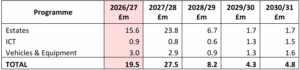
The capital programme set out above includes:
Estates Programme
The Estates programme is based on the approved Asset Strategy and Estates delivery plan, and includes:
• A new shared vehicle workshop with Police
• Two New/Replacement Fire Stations
• Improved Breathing Apparatus facilities
• Investment in training facilities
• Improvements to aging buildings
• Boiler and roof works
• Improvements to station training facilities and drill towers
• Accessibility improvements
DDaT (ICT) Programme
The DDaT programme is based on the Digital Strategy and includes:
• Ongoing replacement of laptops, mobile devices and monitors
• Digital radios and infrastructure
• Control Room and other essential systems
• IT hardware, servers, technical equipment & infrastructure
Vehicle replacement
The programme provides for planned vehicle replacements and the cost of vehicle replacements below the insurance threshold as a result of accidents, along with operational equipment replacement including:
• Up to 10 replacement Fire Appliances
• Aerial Appliance
• Rolling vehicle replacement programme
Decisions on planned capital expenditure should be made in accordance to all relevant and approved strategies. These include:
- The Police, Fire and Crime Plan: ‘Safe and Sound’ – As the overarching strategic document across both fire and police, it is vital that all major cost decisions can be tested against it to ensure they are made in support of its primary objectives.
- CRMP (Community Risk Management Plan) – As a primary operational strategic document for any Fire Service, it is important that capital spending results in operational assets and benefits that underpin its objectives.
- Sustainability Strategy – Most capital projects will have an environmental impact and should be made in support of sustainability objectives.
- Assets Strategy – This provides the basis for strategic decisions on estate, vehicles and commercial activity.
- Digital Strategy – This provides the basis for strategic decisions on Information Technology and Data projects.
- Treasury Management Strategy – Capital expenditure should be affordable, sustainable and prudent, and tested against prudential indicators as detailed later in this document.
As described within these strategies, investment in and disposal of capital items should be made with consideration to improving social value, providing value-for-money and protecting public assets.
At least once per year, the PFCC chairs an Estates Board with the Chief Constable and Chief Fire Officer in attendance to consider strategic estates requirements. The intention of a joint estates board is to explore all joint accommodation needs, options and opportunities across both Fire and Police.
Every year, all other capital proposals are further refined and challenged and are included within the revenue and capital budget proposals.
The programme is collated by the Joint Finance Team who calculate the financing cost (which can be nil if the project is fully funded from other resources).
The proposed capital programme is then reviewed by Chief Officers and the OPFCC. The final capital programme is then presented to the Accountability Board in January of each year for approval by the PFCC as part of the budget discussions. This Strategy refers to
the version of the programme approved in January 2025.
Detailed monitoring will be shared and discussed by finance personnel and budget holders regularly. An overview of expenditure and progress will be included as part of the monthly Budget Monitoring Report which is shared with the Chief Constable and
Senior Officers, the PFCC s151 Officer and the PFCC. This includes a formal mid-year and outturn review at the Accountability Board, chaired by the PFCC.
The Joint Fire and Police Assistant Chief Officer meets quarterly with all departmental Heads of Department to review requirements and progress against the plans.
All capital expenditure must be financed either from external sources (government grants and other contributions), the PFCC’s own resources (revenue, reserves and capital receipts) or debt (borrowing, leasing etc). This is detailed further in the annual Treasury Management Strategies.
When a capital asset is no longer needed, it may be sold so that the proceeds, known as capital receipts, can be spent on new assets or to repay debt.
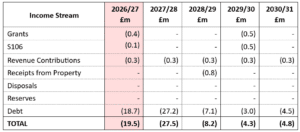
The planned financing of the above expenditure is as follows:
Table 2: Financing of the Capital Programme
Revenue Impact of the Capital Programme (inc. Minimum Revenue Provision)
Where the PFCC finances capital expenditure through borrowing (debt) resources must be set aside to repay that debt from the revenue account. The amount charged to revenue account for the repayment of borrowing is known as the Minimum Revenue
Provision (MRP). Planned MRP is included along with the other budgeted revenue implications of the capital programme as follows:
Table 3: Revenue Impact of Capital Financing
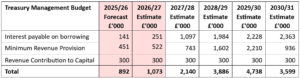
These budgets and forecasts will be updated in the Treasury Management Strategy each year to take into account changes to the capital programme, prevailing interest rates and other variations to available funding.
The Statutory Guidance issued by the government sets out options for calculating the MRP. The recommended MRP policy is:
- For capital expenditure incurred before the 1st April 2008 the policy is based on the 4% reducing balance method, as required under statute.
- From the 1st April 2008 for all unsupported borrowing the MRP policy will be the Asset Life Method (Equal instalment approach) – the MRP will be based on the estimated life of the assets.
- The Commissioner’s policy is to finance shorter life assets from capital receipts, grants and revenue contributions. Where possible, borrowing is reserved generally for Land & Buildings, or Fleet and Digital projects which cannot be financed from the PFCC’s own resources.
Cumulative outstanding ‘debt finance’ is measured by the Capital Financing Requirement (CFR). This increases with new debt-financed capital expenditure and reduces with MRP repayments and capital receipts used to replace debt.
Projected levels of the NCFRA’s total outstanding debt (which comprises borrowing and leases) are shown below, along with the capital financing requirement:
Table 4: Capital Financing Requirement (Borrowing)
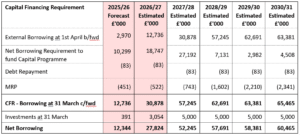
NB. Subject to rounding’s
Although capital expenditure is not charged directly to the revenue budget, interest payable on loans and MRP are charged to revenue, offset by any investment income receivable. The net annual charge are known as financing costs, which is compared to the net revenue stream i.e. the amount funded from Council Tax and core government grants.
Table 5: Prudential Indicator: Proportion of financing costs to net revenue stream.

The NCFRA’s main objectives when borrowing are to achieve a low but certain cost of finance while retaining flexibility should plans change in future. These objectives are often conflicting, and the authority therefore seeks to strike a balance between historically cheaper short-term loans and long-term fixed rate loans where the future- cost is known but may be higher.
External debt at 31st March 2026 was £2.888m, made up of a single PWLB loan with an interest rate of 1.98%.
Statutory guidance is that debt should remain below the capital financing requirement, except in the short-term.
All borrowings should be made following guidance from experienced treasury advisors, scrutiny by the Section 151 officer and formal authorisation by the PFCC.
The NCFRA is legally obliged to set an affordable borrowing limit (also termed the authorised limit for external debt) each year. In line with statutory guidance, a lower “operational boundary” is also set as a warning level should debt approach the limit, currently:
Table 6: Prudential Indicators: Operational Boundary and Authorised Limit
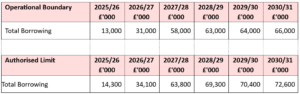
These are based on the agreed 2026/27 capital programme and recalculated each year as part of the updated Treasury Management Strategy.
Treasury management is concerned with keeping sufficient but not excessive cash available to meet the NCFRA’s spending needs, while managing the risks involved. Surplus cash is invested until required, while a shortage of cash will be met by borrowing, to avoid excessive credit balances or overdrafts in the bank current account. Cash balances will fluctuate seasonally due to the timing of grant receipts and there is daily oversight to manage this. Any revenue cash surpluses are offset against capital cash shortfalls to reduce overall borrowing.
Treasury investments arise from receiving cash before it is paid out again. Investments made for service reasons or for pure financial gain are not generally considered to be part of treasury management.
The NCFRA’s policy on treasury investments is to prioritise security and liquidity over yield; that is to focus on minimising risk rather than maximising returns. Surplus cash is invested securely, for example with the government, other local authorities, selected
high-quality banks and pooled funds, to minimise the risk of loss.
The effective management and control of risk are prime objectives of the NCFRA’s treasury management activities. The Treasury Management Strategy therefore sets out various indicators and limits to constrain the risk of unexpected losses and details the
extent to which financial derivatives may be used to manage treasury risks.
Governance: Decisions on treasury management investment and borrowing are made daily and are therefore delegated to the Joint Finance Team who must act in line with the Treasury Management Strategy approved by the PFCC and the agreed reporting requirements.
The NCFRA does not make any investments directly into local public services i.e buying shares or investing in local businesses to promote economic growth.
The NCFRA does not invest in any commercial property / activities.
In addition to current debt of £2.888m (as at 31st March 2026 – see above), the NCFRA is committed to making future payments to cover any Local Government Pension Scheme (LGPS) pension fund deficits. These are determined by the scheme actuary based on triennial valuations, the most recent of which was at 31st March 2026, which has notably decreased the level of contributions from 2026/27. There is also a provision to cover the risks of potential losses arising from ratepayers successfully appealing the level of their property’s rateable value. Earmarked reserves are in place to cover other unplanned liabilities including £0.250m for self-insured public and employer liability claims, where the NCFRA’s claims handlers have advised there is a high probability of economic benefits being transferred.
The NCFRA has a general fund and earmarked reserves set aside to mitigate or smooth unforeseen or unexpected pressures on annual expenditure and manage the financial risks of major incidents.
The NCFRA publishes a Reserves Strategy alongside the Treasury Management and Capital Strategies to support the annual budget, Medium Term Financial Plan and precept proposals.
Further details on liabilities are also contained within the annual statement of accounts.
Due to the long-term nature of capital expenditure and financing, the revenue budget implications of expenditure incurred in the next few years will extend for up to 50 years into the future.
The NCFRA employs professionally qualified and experienced staff in senior positions with responsibility for making capital expenditure, borrowing and investment decisions.
Where staff do not have the knowledge and skills required, use is made of external advisors and consultants that are specialists in their field. The NCFRA currently contracts MUFG as treasury management advisors. This approach is more cost effective than employing such staff directly, and ensures that the NCFRA has access to knowledge
and skills commensurate with its risk appetite.