
Northamptonshire
Fire and Rescue
Service


Reserves are a key part of medium-term financial planning with other components including revenue spending plans, income forecasts, potential liabilities, capital investment plans, borrowing and council tax levels. Decisions on these are inter-linked. Consequently, some organisations will need to maintain reserves at higher levels than others.
All publicly funded organisations should have a reserves strategy to demonstrate transparency and accountability, to comply with best practice financial management and to justify the levels of reserves held.
The PFCC maintains reserves to provide a measure of protection against risk. Without this protection, any unforeseen expenditure would have to be met either by increases in Council Tax or immediate savings (potentially through reductions in service levels).
The term “reserves” has a variety of technical and everyday meanings, depending on the context in which it is used. In this strategy, it is taken to mean funds set-aside at the PFCC’s discretion for general or specific future purposes.
Reserves are required to protect and enhance the financial viability and in particular:
• To maintain a degree of in-year financial flexibility.
• To enable the PFCC to deal with unforeseen circumstances and incidents.
• To set aside monies to fund major developments in future years.
• To enable the PFCC to invest to transform and achieve improved service effectiveness and efficiency.
• To set aside sums for known and potential liabilities.
• To provide an operational contingency at service level.
Reserves should not be held to fund ongoing revenue expenditure as this is unsustainable in the long term. However, they may be important in smoothing a major financial imbalance (revenue or capital) over a longer timescale. CIPFA Bulletin 13 – Local Authority Reserves and Balances (Updated) published March 2023 states:
“Balancing the annual budget by drawing on general reserves may be viewed as a legitimate short-term option. However, it is not normally prudent for reserves to be deployed to finance recurrent expenditure. CIPFA has commented that councils should be particularly wary about using one off reserves to deal with shortfalls in current funding. Where such action is to be taken, this should be made explicit, and an explanation given as to how such expenditure will be funded in the medium to long term.”
The Northamptonshire Commissioner Fire and Rescue Authority (NCFRA) was established on the 1st January 2019 with no transfer of reserves agreed as part of the business case. As such, a three year financial stability period was set to establish a more stable budget position, supported by a sufficient level of reserves.
Since 2019, tight financial planning, together with assistance from the Home Office enabled a sufficient level of reserves to be built up. However, work on the budget and Medium-Term Financial Plan has identified that the financial risks from inflation and other pressures are still forecast to be higher than funding available to the service. Despite annual efficiency targets, funding deficits are identified in future years.
The reserves strategy assumes that the Medium-Term Financial Plan (MTFP) is broadly balanced on a sustainable basis across the five year planning period. If the financial impact of current economic conditions continues to impact on tax base and council tax levels over the medium term, then this could impact on those assumptions.
This is recognised as a risk as when taking into account the projected shortfalls on the MTFP where savings will need to be achieved to facilitate balancing budgets in future years. If savings cannot bridge the full gap, based on current estimates, as a worst case scenario,
revenue reserves can balance the gap over the five year MTFP to some extent, but this would exhaust available reserves and would impact funding available for investment.
NCFRA have a significant Capital programme requirement. This is continually reviewed to ensure it is both operationally deliverable and affordable.
Reserves should reflect the agreed financial strategy and should represent the quantified impact of risks and opportunities over the planning period, weighted for their probability.
The CIPFA Bulletin includes guidance on the establishment and maintenance of local authority reserves and balances, setting out the key factors that should be taken into account locally in making an assessment of the appropriate level of reserves and balances to be held.
There is information that each PFCC must publish in terms of police reserves. This guidance has also been adopted for NCFRA to ensure consistency across PFCC governed Fire and Police services in Northamptonshire. One of the key requirements is that the information on each reserve should make clear how much of the funding falls into each of the following three categories:
• Funding for planned expenditure on projects and programmes over the period of the current medium term financial plan.
• Funding for specific projects and programmes beyond the current planning period.
• As a general contingency to meet other expenditure needs held in accordance with sound principles of good financial management.
This information is summarised across the Home Office headings as at 31/3/26 as follows:
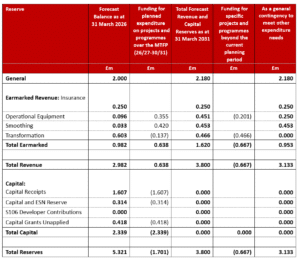
Note: numbers may not sum due to rounding
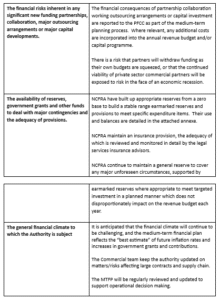
In order to assess the adequacy of the unallocated general reserve when setting the budget, the PFCC, on the advice of the Chief Finance Officer, should take account of the strategic, operational and financial risks facing the authority. This assessment of risk should include external risks, as well as internal risks, for example the ability to deliver planned efficiency savings.
Whilst there is no prescribed level of reserves that PFCCs should hold; it is influenced by individual discretion, local circumstances, advice from external auditors, risk management arrangements and risk appetite. CIPFA guidance specifically cautions against prescriptive national guidance for a minimum or maximum level of reserves and states:
“The many factors involved when considering appropriate levels of reserves can only be assessed properly at a local level. A considerable degree of professional judgement is required. The chief finance officer may choose to express advice on the level of balances in cash and/or as a percentage of budget (to aid understanding) so long as that advice is tailored to the circumstances of the authority.”
However, the minimum level of reserves may be set for the authority by the Ministers in England and Wales where an authority does not act prudently, disregards the advice of its chief finance officer or is heading for financial difficulties.
CIPFA indicate a minimum general reserve level is typically between 2% and 3% of net budget requirement.
Despite progress in building reserves, NCFRA still has one of the lowest level of reserves per core spending power across all Fire and Rescue Authorities in England and Wales.
The PFCC has considered the reserves strategy and wishes to hold a sufficient but not excessive level of reserves. In determining this position, Annexe 1 outlines how the PFCC complies with the 7 key CIPFA principles which can be used to assess the adequacy of reserves.
NCFRA have also considered the following factors:
• NCFRA are required to meet costs up to a certain threshold for any claims for extraordinary funding to cover large-scale unplanned events.
• NCFRA was established without the transfer of any reserves.
• Local funding accounts for some 80% of NCFRA’s funding streams, which can be affected by local taxpayers and business’ ability to pay and are subject to volatility.
• The general reserve also holds the financial risk of any potential industrial action requirements should they arise.
Given the above, it remains prudent to hold reserves at a reasonable level to provide a realistic and comfortable buffer to meet any eventualities, and to mitigate against any unplanned in year changes being required.
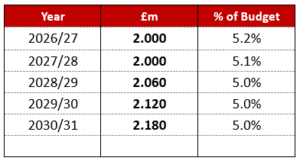
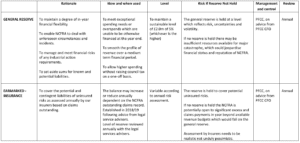
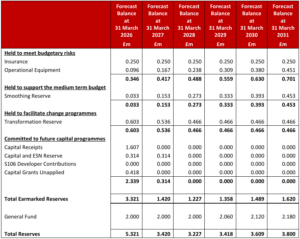
The Chief Finance Officer advises that it would be prudent to maintain a sustainable and resilient level of general reserves at £2.0m or 5% of revenue budget (whichever is the higher).
At present, there are no plans to use the general reserve during the period of the MTFP or longer term. An annual revenue budget contribution of £60k has been included across the MTFP to ensure funds are above 5% of revenue expenditure in each year as follows:
In addition to the general reserve, the PFCC holds a number of reserves which are earmarked for specific purposes.
At the 31/3/2026, it is estimated that the PFCC will hold £5.321m for Fire in earmarked reserves. The predicted position for each earmarked reserve as at 31/3/2026, together with further details is in Annexe 2 and 3.
The purposes of each earmarked reserve are as follows:
• Insurance – To set funds aside where considered prudent for civil claims (Public and Employer liability) in line with professional advice.
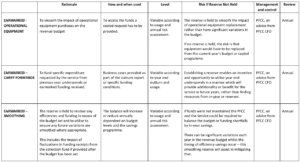
• Operational Equipment – Given the age and condition of equipment transferred as part of the governance transfer, an annual operational equipment reserve contribution was established to smooth the impact and mitigate the costs of essential operational
equipment replacement.
• Carry Forwards – To ringfence previous years’ underspends for specific purposes in the medium term.
• Smoothing – To enable any savings generated to be earmarked and released over future years as needed, smoothing the impact of funding fluctuations and timing of savings programmes on the revenue budget.
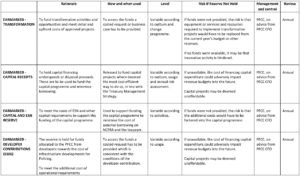
• Transformation – To support initiatives and transformative activities such as investments in technology and other innovation, and in line with operational priorities. This includes funding of resources to deliver Your Future Service.
• Capital Receipts – To earmark receipts for disposal of capital assets for use as deemed appropriate to minimise the cost of future capital financing.
• Capital and ESN Reserve – To hold amounts set aside for capital investment, applied to the capital programme as deemed appropriate to minimise the cost of future capital financing.
This specifically includes funds ringfenced for work associated with
preparedness for Emergency Services Network (ESN).
• Developer Contributions (s106) – To collect the drawn down developer contributions awarded to the PFCC in line with S106 planning arrangements. These funds will be released in accordance with the terms of the agreements, usually to fund capital
expenditure. The reserve only accounts for funds once they have been drawn down.
• Capital Grants Unapplied – To hold amounts grants received for specific capital investment, to be applied to the capital programme in line with the grant terms and as deemed appropriate to minimise the cost of future capital financing.
These reserves will be reviewed on a regular basis and any further opportunities to set aside earmarked reserves to support targeted expenditure and investment will be taken where appropriate.
The CIPFA Statement of Recommended Practice is prescriptive about when provisions are required (and when they are not permitted). A provision must be established for any material liabilities of uncertain timings or amount, to be settled by the transfer of economic benefits.
In accordance with this statutory guidance, there is an established ‘Insurance Provision’ which is reviewed as part of the closedown process for each year.
Any drawdown from reserves is subject to the approval of the PFCC, on advice from the PFCC’s Chief Finance Officer (OPFCC CFO); or under the delegated authority of the OPFCC CFO.
The Local Government Act 2003 requires the Section 151 Officer to report annually on the adequacy of the reserves and this is included within the statement on the robustness of the estimates used for the budget and the adequacy of the proposed financial reserves.
The Strategy will be reviewed annually by the OPFCC CFO as part of the Budget and Precept process.
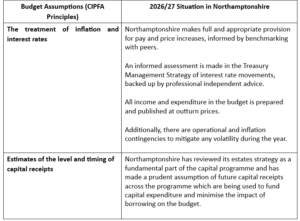
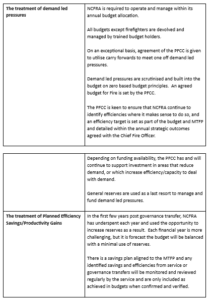

Note: numbers may not sum due to rounding