
Northamptonshire
Fire and Rescue
Service

About this strategy
This strategy sets out the principles which underpin the decisions on the key Asset Functions within the organisation as follows: Estates, Fleet and Commercial. The strategy will inform and underpin the Organisational Capital Programmes.
This Strategy is a long-term strategy to 2040 and beyond. An annual review will take place within the Governance meetings to ensure this strategy remains fit for purpose
and make any necessary adjustments to principles and any associated implementation plan as required.
The document is designed to guide future decision making regarding strategic property investments and disposals and will always need to consider the emerging operational requirements at the time of the decision.

Ensuring a fit for purpose Assets Strategy is vital to any organisation. The key function of this strategy is therefore, to ensure that a framework is provided to help ensure legally compliant and fit for purpose Assets, which support the operational objectives of both Northamptonshire Police and Northamptonshire Fire and Rescue.
An asset can be anything that provides a current or potential future economic benefit to whoever possesses or controls that asset. Assets can include such things as motor vehicles, buildings, land, machinery, equipment, as well as non-physical or intangible assets. The latter are an important class of assets that include things like intellectual property (e.g., patents or trademarks), contractual obligations, royalties, and goodwill. Brand equity and reputation are also examples of non-physical or intangible assets that can be quite valuable.
The aim of Asset Management is to use assets to deliver the objectives and priorities of the organisations, and they have a fundamental part to play in the delivery of these objectives. Assets can no longer be merely viewed as static resources to be managed as best they can with diminishing resources and investments. The more successful and forward-thinking organisations recognise the potential of their assets and the proactive value of asset management. The tendency to focus on the day-to-day operational management of existing assets at the expense of a more strategic approach brings with it some real risks of a disconnect between asset management activity and the corporate objectives and priorities of the organisations.
Between the Office of the Police Fire and Crime Commissioner, Northamptonshire Police and Northamptonshire Fire and Rescue Service there are currently over 80 locations occupied across the County. Most of this estate was designed for a time when the operating models for both Police and Fire were dramatically different from today.
Northamptonshire’s policing estate includes a mix of main policing locations, joint or partnership sites and drop-in locations. The previous strategy started to address a 30-year lack of investment in the estate, setting a direction of travel to deliver a more viable operational policing estate. Further operational requirements have been developed within the Commissioner’s Police, Fire and Crime Plan and the Policing Plan 2025, and this strategy considers those needs.
Following the January 2019 governance change Northamptonshire Fire and Rescue moved from Northamptonshire County Council to the Police, Fire and Crime Commissioner; the ownership and delivery of operational estate has moved to the PFCC. Similarly to policing, the fire estate has had a lack of investment over a significant number of years. Investment is therefore required in both current and future buildings to ensure they remain fit for purpose for a modern emergency service. Further operational requirements have been developed within the Commissioner’s Police, Fire and Crime Plan and the Community Risk Management Plan 2025, and this strategy considers those needs.
The current joint estate contains circa 80 site locations with a site area total approximately 280,000m2 with a gross internal area of approximately 85,000m2. The estate services the Police need with Police Stations, hub sites for administrative activities and bespoke sites for needs such as vehicle maintenance, training & storage. The Fire service needs are accommodated predominantly by Fire Stations with administrative activities undertaken at shared hub sites, along with bespoke needs such as vehicle maintenance & training. Most shared resources are located at the shared hub site with Police & Fire (Darby House). Police & Fire Stations were constructed at a time when services, and those serving, were not as diversified or regulated.
This Joint Strategy enables a focus to be placed on sharing buildings, where appropriate, between police and fire and rescue to reduce on going costs of buildings, enhancing accommodation for staff, whilst also enabling a more efficient and effective approach to support operational business. The estate must support the changing demands placed on both organisations and the organisational strategies to meet these demands.
The vision for the joint estate is to deliver a fit for purpose, modern, efficient and effective estate that meets the needs of all staff and benefits the communities we serve.
The delivery of the Estates Strategy shall be underpinned by the following principles:
– Optimise the joint estate to enable investment in both services
– Optimise the estate footprint increasing sharing between police and fire where this is practical and operationally desirable
– Reduce estate running and maintenance costs, identifying further opportunities for efficiencies and/or collaboration to drive value for money
– Set standards for the quality and professional appearance of buildings which reflect a quality organisation
– A preference for freehold rather than leasehold premises.
– Consolidation of administrative and non-public facing services in fewer, larger hubs to help build resilience
– Work with partners and emergency services, to enable, where operationally viable, sharing of buildings and costs to enhance collaboration and maximise the quality and value for money delivered to the public
– Improved accessibility and visibility
– Ensure that locations chosen are highly visible to enhance public confidence and, where practicable and operationally viable, with partner agencies
– All buildings to be available to both emergency services as required and to be jointly branded, where practicable and operationally viable.
– Flexible estate to meet changing operational needs
– Ability to provide more flexible spaces, including ‘open plan’ areas and reduced cellular space for future adaptation as required.
– Reduce average space per FTE and enable more agile work bases and mobile technologies with less reliance on 1 desk for 1 person
– Enhance property and asset management to improve safety, security and sustainability
– Maintain a disposal and acquisitions policy to underpin decisions on the estate.
– Improve estate wide site security and access systems
– Develop sustainable solutions to mitigate the impact on the environment,
including the increased use of renewable energy across the estate
– Carry out and act upon health and safety inspections across the joint estate
The estate is owned by the PFCC and therefore approval of this strategy and any key decisions regarding strategic property rest with the PFCC. To support the PFCC in managing the estate, the following are the appropriate forums for decision making, prioritising workloads and monitoring progress against agreed delivery plans:
Joint Independent Audit Committee — attended by the Monitoring Officer, Assistant Chief Officer and Section 151 Officers. Aim is to oversee the estates strategy, governance processes and adherence to decision making policies allowing for the approval of Business Cases to achieve the Strategy.
Estates Board — chaired by the PFCC and attended by the Chief Constable and Chief Fire Officer and other senior representatives of the OPFCC, Force & Fire with the responsibility for determining the strategic direction and managing strategic risk. This Board also oversees progress with the implementation of the Estates Strategy and the development and monitoring of key performance indicators for the estate.
Assets and Sustainability Boards — chaired by the ACO Enabling Services, attended by representatives of Fire and the Force, with the responsibility for determining the operational requirement, identifying priority works, monitoring progress across the agreed delivery plans and programmes, monitoring finance (capital and revenue) and managing risk.
Decisions on individual elements of the strategy will be taken through the Assets and Sustainability Board, ensuring operational support from the respective chief officer teams. All key decisions with regards the estate are the PFCCs and will be formally recorded by Decision Record, published on the OPFCC website and shared with the Police, Fire and Crime Panel, when appropriate and necessary.
The Office of the Police Fire and Crime Commissioner, Northamptonshire Police and Northamptonshire Fire and Rescue Service current fleet is multi-faceted to ensure it supports the operational objectives of the organisations but can essentially be divided into two broad categories of vehicle:
- Operational fleet – This covers front line operational response vehicles, which includes, response cars, neighbourhood vehicles, appliances, specialist vehicles, Armed Response Vehicles (ARVs) officer cars, pods, trailers, boats and any other asset, equipped with emergency lighting, markings and sirens.
- Non-Operational fleet – This covers non-operational response support vehicles, to include, protection, prevention, facilities, stores, DDAT, hydrant, equipment, and Breathing Apparatus (BA) vehicles. This category is for those which are not fitted with emergency lighting and sirens.
Also included in the scope is:
- Fleet maintenance
The Fleet Strategy is driven to support a more efficient and effective approach, which must support the changing demands placed on both organisations and the organisational strategies to meet these demands. Therefore, this is underpinned by the following principles:
- To provide a healthy, safe, compliant and comfortable vehicle fleet
- To provide a sustainable carbon efficient Fleet
- To drive efficiency and value for money
Each of these principles is briefly explained below:
A healthy, safe, compliant and comfortable vehicle fleet
To ensure this key objective is achieved the following principles of fleet management will be adopted:
- Delivery of a comprehensive and cost-effective vehicle maintenance and ‘safety’ inspection regime to fleet vehicles, ensuring vehicles are maintained in a timely and efficient manner to minimise vehicle downtime and maximise vehicle availability and are fully compliant with legislation and associated standards and guidance.
- Liaising with all key stakeholders to identify and evaluate vehicle suitability for role using the following measures:
- a. existing fleet mix
- b. parts availability
- c. technical expertise
- d. manufacturer support
- e. specialist tools
- f. fuel type
- g. performance
- h. load capacity
- i. vehicle evaluation by personnel
- j. suitability for role
- k. environmental considerations
- l. vehicle whole-life costs
- m. health & safety
- n. compliance with National Association of Police Fleet Managers (NAPFM) and NFCCTMO stipulations and conformance with police/fire contract requirements
- o. Driving Licence Requirements
- Provision of defect reporting tools and processes that are fit for purpose ensuring all users are aware of the reporting arrangements.
- Review options for modernising / automating the driver inspection process
- Arranging timely collision repairs in liaison with accident management contractors and the body repair contractors, directly or via third parties
- Decommissioning of police and fire vehicles and equipment in a timely and cost-effective manner using national framework disposal arrangements to maximise capital receipts
- Carrying out quality control inspections, technical assessments, and diagnostic checks in compliance with the vehicle manufacturers recommended standards
- Introduce a departmental “Comms Plan” to ensure up to date, relevant and helpful information is available to all users of the fleet; to include regular engagement with Operational Leads and Heads of Departments.
- Support the work of the Culture Board, People Boards and H&S Board, implementing changes to the fleet where required, and affordable.
- Production and management of a suitable vehicle replacement plan: –
- a. The vehicle replacement programme is based upon strategically derived allocated capital funding. Vehicles are replaced on an annual rolling programme determined principally by mileage and/or age criteria to ensure the vehicle fleet remains cost effective and reliable within the constraints of the allocated vehicle capital budget.
- b. The vehicle replacement programme reflects the affordability to replace existing vehicles with new vehicles within budget.
- c. Any changes to these criteria will be discussed by the Vehicle User Group with any changes being presented to the Asset and Sustainability Boards.
To provide a sustainable carbon efficient Fleet
We will seek to reduce the adverse environmental impact of our activities. The aim is to encourage the efficient use of resources through the minimising of waste and through the conservation, re-use and recycling of resources wherever possible.
Working towards UK Government vehicle emission targets in 2035 the Department will continue to manage the introduction of fit for purpose alternative fuelled vehicles. The Department will also continue to work in association with the Property Department to develop the electric vehicle charging infrastructure.
To ensure progress continues towards achieving these targets the following emission reduction ambitions will be progressed:
To review developments and opportunities in alternative fuel types and carry them through to the vehicle replacement policy and procurement strategy where suitable. The evaluation of new developments in vehicles will be assessed in terms of operational fitness for purpose, ease of maintenance, ease of use, environmental impact, and affordability. Evaluation of potentially suitable products will be in conjunction with operational colleagues.
Enhance the analysis of data available from Telematics; for example, reduce “idling” whilst vehicles are in police station geo-fences
Purpose alternatively fuelled vehicles where the role and budget allow.
Engage with a specialist consultant to develop a Sustainability plan (this is wider than the Organisations vehicle fleets as this will need to incorporate the whole Organisational emissions, including grey fleet, commuter mileage and that of our suppliers)
Review opportunities to increase waste management opportunities and where possible re-use rather than dispose of vehicle related waste (redundant seats, batteries etc) and consider opportunities to reuse fit for purpose vehicle equipment on more than one vehicle life.
Continued relevant training for the maintenance and repair of alternatively fuelled vehicles.
To drive efficiency and value for money
This strategy will ensure that as far as is possible, an intelligence led approach will apply in optimising whole-life value. It is essential that the operating costs of running the Fleet are effectively managed to ensure costs are minimised as far as is practicable. The Fleet budget amounts to £10.7m, broken down as follows;
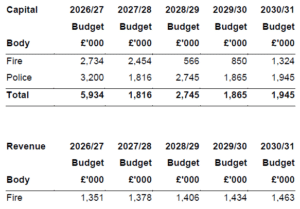

To achieve this objective, the following financial management processes and measures will be adopted:
Effective capital investment
- Annual / 5-year vehicle replacement programme to be considered by the Asset and Sustainability Board, with a prioritised plan being provided to the Chief Officer Team(s) and the OPFCC and built into the Medium-Term Financial Plans. The vehicle replacement programme uses the criteria detailed earlier and is based on a whole life cost approach
Effective revenue spends
-
- a. Utilise national framework procurement contracts for vehicle related services to include fuel, fuel cards, tyres, ancillary equipment and vehicle disposal.
- b. Utilise telematics data to challenge vehicle utilisation, improve driving standards, investigate accusations of poor driving, improve fuel economy, provide vehicle accident data and to locate vehicles at locations to match operational demand
- c. Monthly review of spend and commitments
- d. Review planned service intervals to ensure vehicles remain safe and compliant whilst still delivering value for money.
Efficient procurement
-
- a. Utilise the National Blue light Commercial, or other suitable, vehicle purchasing framework for new vehicles
- b. Work closely with the Commercial Team to ensure vehicles and associated parts and services are provided in the most cost-effective way and in accordance with appropriate procurement regulations and the PFCC’s scheme of delegation.
Contractor / Contract Management
- Ensure effective monitoring processes are in place to ensure all contract deliverables are being provided and seek support of the Commercial team where necessary.
Exploiting of funding opportunities
Develop process for ensuring all funding opportunities are known and actioned as required, including but not limited to:
-
- a. Section 106 developments
- b. Community Infrastructure Levy
- c. Regeneration Bill
- d. Sponsorship
Fleet rationalisation, aligning the size of the fleet to operational need with the aid of vehicle telematics to:
-
- a. Adopt a planned and structured approach to engage with all Operational and Non-Operational fleet stakeholders to better understand their requirements and use of their allocated fleet
- b. Maximise efficiency in fleet utilisation
- c. Management of any increases in the fleet establishment requests via the Force’s a business case procedure. This ensures that a formal justification is evidenced and placed in context of this Fleet Management Plan and is authorised by operational and financial managers. It also entails matching the vehicle request to the authorised vehicle specification to comply with legislative and requirements and ensure that the vehicle is fit for the purpose of the designated operational role.
Produce and implement an accident reduction plan (ARP), detailing number of accidents per annum and projected savings the key objectives of which will be:
-
- a. To support the reduction in vehicle related accidents, particularly those that occur at low speed and whilst manoeuvring.
- b. To raise awareness of the causes of vehicle accidents and promote effective preventative measures to reduce such accidents.
- c. To provide information to Driver Training Teams to enhance the training programmes
There is currently no national benchmarking data available to assess the performance of our fleet against others in respect of both Policing and Fire and Rescue Services.
Work is underway within both National Working Group on the development / collation of such data which the Department shall engage with once launched.
The projected life of each vehicle type has been reviewed in recent years and is currently as follows:

Whilst there is no formal sector or national benchmark for vehicle life, the terms above are unquestionably at the top end of any fire sector comparator data sets. Any changes to these criteria will be discussed by the Vehicle Advisory Group with any changes being presented to the Asset and Sustainability Board.
In recent years a capital programme for replacement vehicles for the fire and rescue service has been underway with 8 new Fire Appliances, an aerial platform and new officer cars being funded and rolled out. Further investment within the duration of this strategy is also underway with an additional 8 new fire appliances to replace existing end of life assets and a new aerial appliance to replace the existing end-of-life CARP. Additional investment into non-operational vehicles is also being progressed.
Despite this additional investment, it does mean that whilst still fit for purpose, some of the existing fleet is already beyond scheduled life. This legacy will take several years to overcome and will require careful management of the existing fleet across the life of this strategy to ensure continuity.
This is likely to mean increased revenue and maintenance costs and potentially increase risk to the Fire and Rescue Service until the fleet comes back within the lifeing policy of the service.
Prioritisation will be based on the most efficient way to deliver the outcomes in this strategy whilst ensuring the delivery against the CRMP and ensuring the safety of staff and the community.
A regional exercise undertaken by the Fleet Manager in January 2023 identified the following ratios of officers per vehicle across the East Midlands region. This data identified that Northamptonshire Police have the second smallest ratio of officers per vehicle across the East Midlands, however a more accurate comparison would be achieved by comparing similar data with the Home Office identified ‘most similar’ forces. This data provides a baseline for further work as it maybe we have different operational practices to other forces (i.e., single / double crewing).
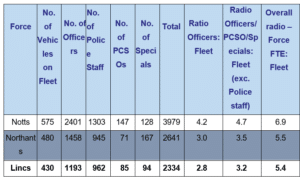

In general, Operational Cars shall range from 3-5 years depending on the function and use, However, Vehicles Life, especially in respect of Response and NPT will be reviewed at 100K miles and a decision made on actual replacement mileage. Mileage replacement is the preferred, cost-effective parameter rather than no of years old. Vehicles may be replaced earlier if recurring defect is identified without resolution and on emissions to improve carbon output and mpg.
Any changes to the above criteria will be discussed by the Vehicle Advisory Group with any changes being presented to the Asset and Sustainability Board
A refreshed capital programme for replacement vehicles for the Force is being reviewed during the first 2 years of this strategy. This shall be aligned, where possible and appropriate, to the national work under the PECP programme being led by the Home Office, together with BLC and national groups to look at the standardisation of operational vehicle specifications for the Police Forces. Additional investment into non-operational vehicles is also being progressed and where possible alternative fuelled solutions.
Despite this additional investment, it does mean that whilst still fit for purpose, some of the existing fleet is already beyond scheduled life. This legacy will take several years to overcome and will require careful management of the existing fleet across the life of this strategy to ensure continuity.
This is likely to mean increased revenue and maintenance costs and potentially increase risk to the Force until the fleet comes back within the lifeing policy of the service.
Prioritisation will be based on the most efficient way to deliver the outcomes in this strategy whilst ensuring the delivery against the Force Priorities and ensuring the safety of staff and the community.
This Plan supports the corporate planning framework, specifically the requirements of the PFCC’s Capital Strategy 2025/26 which provides the mechanism by which capital investment and financing decisions can be planned in the short to medium (5-year) term.
The Capital Strategy sets the framework so the PFCC can provide the assets required for future service delivery by the force, ensuring the force and service has “sound money management” as set out in the PFCC Safe and Sound Plan.
The Fleet Plan will set out a coherent plan for effective fleet deployment and usage across the County for both organisations which support local service delivery in the most cost-effective manner and for the vehicle replacement programme. The Fleet Management Plan will also identify the replacement programme required to ensure a fit for purpose, legal complaint and reliable fleet to support the demands of the organisations.
The Fleet is owned by the PFCC and therefore approval of this strategy and any key decisions regarding strategic fleet investment rest with the PFCC. To support the PFCC in managing the fleet, the following are the appropriate forums for decision making, prioritising workloads and monitoring progress against agreed plans:
Joint Independent Audit Committee — attended by the Monitoring Officer, Assistant Chief Officer and Section 151 Officers. Aim is to oversee the Assets strategy, governance processes and adherence to decision making policies allowing for the approval of Business Cases to achieve the Strategy.
Assets and Sustainability Board — chaired by the ACO Enabling Services, attended by representatives of Fire and the Force, with the responsibility for determining the operational requirement, identifying priority works, monitoring progress across the agreed delivery programmes, monitoring finance (capital and revenue) and managing risk.
Fleet Advisory Group (Police) – An internal Vehicle User Group is established in which provides a forum for operational users and the Fleet Manager to discuss a range of fleet related topics, including but not limited to, allocation of the fleet, specification of requirements, any regulatory or statutory changes, the replacement plan, vehicle equipment, telematics data and identification of any risks.
Equipment and Fleet Advisory Group (Fire) – An internal User Group is established in Fire which provides a forum for operational users and the appropriate Managers within Assets to discuss a range of Asset related topics, including but not limited to, allocation of the fleet, specification of requirements for all Assets, any regulatory or statutory changes, the replacement plan for Assets, Equipment and identification of any risks.
Decisions on individual elements of the strategy will be taken through the Assets and Sustainability Board, ensuring operational support from the respective chief officer teams via their appropriate governance frameworks. All key decisions with regards Fleet are the PFCCs and will be formally recorded by Decision Record, published on the OPFCC website and shared with the Police, Fire and Crime Panel, when appropriate and necessary.
All public sector organisations currently find themselves in an extremely challenging environment, with mounting financial pressure, reduced resources and greater market competition. Northamptonshire Police, Fire and Crime Commissioner has responsibility for setting the budget for Northamptonshire Police and Northamptonshire Fire and Rescue Service. Police and fire funding is made up of a mixture of government grants and money from local taxpayers.
Set in the context of the COVID-19 pandemic, a growing population and a financial settlement that will not meet the costs of inflation. This year, the financial picture is uncertain; the challenge for us is to find ways of sustaining the improvements in the services that we have made and meet the priorities for further improvement.
We recognise the need to take more control of our own destiny and become a more commercially focused and financially sustainable. One which embraces a more commercial culture in terms of how we think and act to ensure that we deliver high quality services as efficiently and effectively as possible.
In doing so, we shall continuously seek new opportunities to generate income, recover our costs and achieve value for money in all our commercial transactions. We shall invest in projects which provide a good return on investment whilst recognising the social and community value.
This commercial strategy aligns closely with other key strategies including digital transformation, workforce and skills development, and the Estate and Fleet sections of this strategy. Each of these contribute towards our ambition to make Northamptonshire Police, Fire and Crime Commissioner a leader of innovation, enterprise, and growth which others will aspire to and wish to collaborate with to ensure we deliver the best outcomes for the communities we serve.
This commercial strategy sends out a strong signal that Northamptonshire Police, Fire and Crime Commissioner are embracing commercial innovation. We will work with partners who share our ambition and values, and we shall continue to put the best interests of Northamptonshire residents at the heart of everything we do to ensure we are able to deliver the most efficient and effective services.
To support in the delivery of our Commercial Vision and Purpose we venture to deliver the following:
Outcome One:
• To generate revenue and efficiency savings, where possible, in our commercial activity, whilst ensuring we support the delivery of quality services to Northamptonshire residents.
Outcome Two:
• To build strong working partnerships with public, private and third sector organisations to maximise collaboration and stimulate financial savings
Outcome Three:
• To embed a commercial culture within the organisations, supporting our staff to embrace innovation and produce new ideas through workshops and training sessions.
Outcome Four:
• Deliver a joint commercial pipeline that is aligned to the Medium-Term Financial Strategies whilst demonstrating a return on investment.
Outcome Five:
• To stimulate commercialism and trading opportunities in order to further the commercial development of the services and deliver wider benefits to the community.
Realising the outcomes
It is recognised that to achieve the outcomes we shall need to adopt key principles in our commercial activities:
Communication
• Endorsement from the Commissioner and Chief Officers and supported by all senior leadership teams
• Ensure transparency and effective communication
• Ensure clarity on the ‘non-chargeable’ and ‘chargeable’ service
• Transparency on the Specialist Services Charges, Expenditure and
Investment
• Actively market our income generation opportunities
• Listen to our staff, providers, service users and customers
• Advertise, where possible, all commercial opportunities to work with our services
Intelligent and Agile
• Embrace transformation
• Positively challenge methods of delivery or proposal to encourage growth and change
• Know when to stop doing something that add no value or benefit
• Greater focus on procurement and contract management
• Know the marketplace and act competitively
• Establish a strong commercial culture and uplift staff skills
• Facilitated by a highly-skilled commercial team
• Pursue opportunities to generate efficiencies and savings
• Maximising value from our assets and income streams
Innovation
• Embrace commercialism and make the most of opportunities for
income/revenue
• Create and encourage ideas for change or new opportunities/ways of working
• Nurture and develop those ideas at the most appropriate time
• Actively seek and work with our partners commercially to innovate new methods
• Encourage use of digital and technology to enhance delivery
• Exploring opportunities to sell and share our services
Social Value and Sustainability
• Demand more from service providers and contracts to support social outcomes in our communities
• Drive the return on investment to fund services
• Making every penny count and achieve annual targets
• Drive digital enablement, product sets and efficiencies that offer longevity for the services
• Dispose of assets when the market is no longer viable
• Robust financial and commercial service programmes aligned to the corporate plan
• Plan for the future to ensure financial stability against the MTFPs and closure of the funding gap
• Effective and proportionate risk management
• Strategic and operational planning
• Access government grants and other funding
• Spend to save initiatives.
Compliance
• Develop and operate within a strong corporate governance model
• Timely reviews of governance processes
• Assure adherence to legislative provisions for all commercial activities
• Act with integrity and high ethical standards
• Protect public funds and manage financial risks effectively
• Ensure we get value for money for our residents
• Rigorous approval processes and project scrutiny
• Following corporate risk management and mitigation procedures
• Effective management of contracts
• Meticulous due diligence